The digital future of construction in practice: Seven bachelor's theses from the Digital Construction degree programme 2026
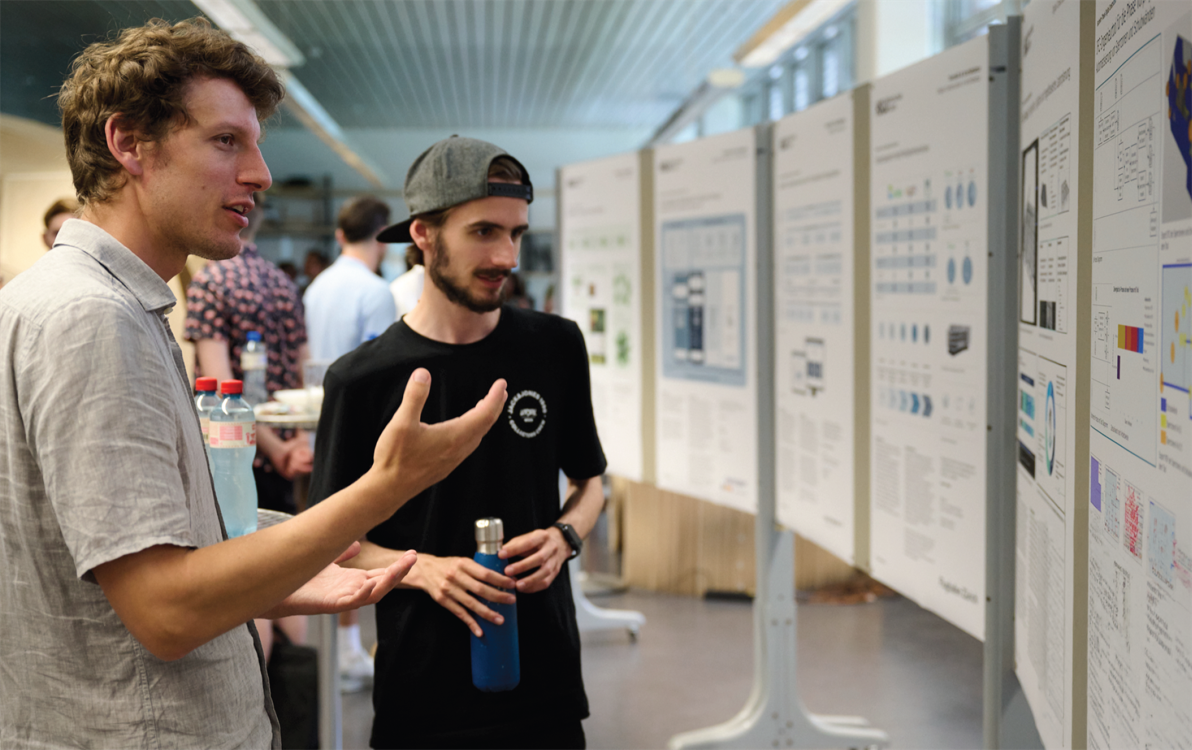
This year, 20 bachelor's theses were completed in the Digital Construction degree programme at Hochschule Luzern (HSLU) and presented at the exhibition on 1 July 2026. Martin Loučka, Managing Director of ioLabs AG, teaches the Scripting module at HSLU as a lecturer and this year also had the opportunity to supervise and assess seven of the theses as an industry expert — so he already knew some of the students from his teaching. What connects these theses: they all tackle real, practice-oriented questions from the construction and real estate industry — and solve them using the latest digital methods. Below is a brief overview of the individual topics.
Pascal Brotschi – Linking information requirements and external data sources with IFC models in an openBIM process
Industry partner: AFRY Schweiz AG
Pascal developed a working prototype that brings together IFC models, IDS-based information capture and validation, and the dynamic linking of external data sources. Through a relational database with a Virtual Knowledge Graph layer, building data can be used interoperably across communicating systems — a concrete step towards seamless data flows over the entire lifecycle.
Raphael Gremaud – Usage-based energy and performance metrics from operational data
Industry partner: Amstein + Walthert Bern AG
Raphael explored how reliable, usage- and room-specific energy and performance metrics can be derived from real operational data of building services (MEP) systems. He developed a methodology for plausibility-checking and quality assessment of the operational data, linked it with BIM/IFC models, and used Machine Learning (quantile regression) to determine design values relevant to planning — thereby closing the feedback loop between operation and design.
Dominic Hohenfeld – Rule-based automation of volume studies in early project development
Industry partner: Amenti AG
Dominic automated the creation of volume and massing studies in early project development. His hybrid approach combines parametric-deterministic rules with data-driven and AI-supported elements. The prototype evaluates plots based on hard and soft factors, generates and ranks variants, and was validated on ten parcels across seven cantons — including automatically generated evaluation documents.
Juri Jerg – Digital process integration of a hybrid Timber-Earth-Slab fabrication
Industry partner: Technical University of Munich
Juri developed a schema-driven, component-agnostic pipeline for the digital process integration and automation of a hybrid timber-clay slab. Particularly impressive: he was able to empirically demonstrate the transferability of his approach by applying the same control logic, without modification, to a second application domain (facade panels) — a genuine contribution to the generalisability of robotic fabrication processes.
Jan Kaufmann – From Digital Twin to Digital Twin Environment
Industry partner: beyondBIM
Jan designed and prototyped how a central data platform can manage heterogeneous target systems across system boundaries. His approach shifts the focus from the "Single Point of Truth" towards an orchestrating "Digital Twin Environment" layer. The working prototype connects different systems via a node-based Any-to-Any transformation and openly addresses governance, security, and cost-effectiveness.
Anna-Lena Lehner – Interoperable Lifecycle Data Management based on openBIM standards
Industry partner: Bauen digital Schweiz
Anna-Lena investigated how building data can be managed interoperably across the lifecycle based on openBIM standards (including IDS, bSDD, CDE). In a Proof of Concept, she ran through an end-to-end workflow spanning several tools and quantified concrete gaps — such as the proportion of objects and properties without semantic linking — as a basis for specifically reducing media discontinuities.
Jonas Weiss – Automated generation of MEP space requirements from BIM volume models
Industry partner: Penzel Valier AG
With his prototype "Nexara MEP", Jonas demonstrated a way to automatically derive the space requirements for MEP routing from BIM volume models as early as the initial planning phases. Using pathfinding methods (A*), routing volumes are abstracted, shafts are aggregated, and the result is exported as IFC. He validated the results on multiple levels — including a manual comparison and feedback from practice.
The degree programme impressively demonstrates the breadth of what is taught here: from the BIM method through generative design and applied research to process optimisation and lifecycle data management – complexity reduced and solved in a practice-oriented way. This interplay of specialist knowledge, digital skills and an understanding of the entire value chain opens the door for Digital Construction students to exciting and meaningful job opportunities.